Next-Gen Content Delivery
An AI-native knowledge delivery system for researchers
An intelligent research content delivery platform that understands research, adapts to users, and accelerates discovery — not just access.
Built around researchers, not files. Every scholarly object becomes enriched, searchable, explainable, and connected — with responsible AI and compliance embedded at every stage.
- ●From static publishing to intelligent research delivery.
- ●Deliver any scholarly content format — beyond PDFs.
- ●Make content discoverable, explorable, and explainable.
- ●Use AI to reduce reading time and increase insight.
- ●Ensure global compliance, indexing, and preservation.
Platform pillars
Ten layers of researcher-first delivery
Modern STM delivery requires intelligence, personalization, trust, and interoperability — not just hosting.
Universal content intelligence
Every research object becomes machine-understandable with classification, tagging, extraction, and equation recognition.
AI-powered discovery
Semantic search, concept-based discovery, and cross-disciplinary linking built for how researchers think.
Smart reading layer
Section summaries, key contributions, limitations, and figure explanations to reduce cognitive load.
Personalized research
Adaptive feeds, alerts, and reading paths informed by interests, citations, and career stage.
Knowledge graph engine
Connect authors, institutions, methods, datasets, and topics to reveal lineage and novelty.
Global indexing & compliance
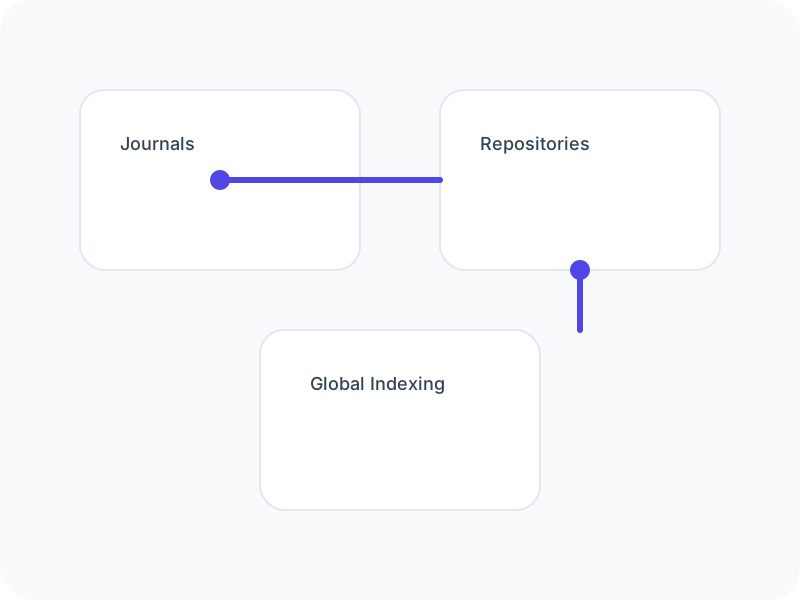
Automated submission to major indexes with OA policy checks and preservation readiness.
Collaboration & annotation
Shared notes, lab collections, and AI-assisted annotations turn reading into team knowledge.
Research integrity signals
Retraction alerts, transparency badges, and statistical red flags for trusted reading.
Multimodal & multilingual
Translations, audio narration, and accessible formats for global research audiences.
Researcher APIs
Integrations for reference managers, lab notebooks, LMS tools, and analytics systems.
Universal content intelligence
Every research object becomes machine-understandable
Automatic classification, section-level tagging, figure extraction, and equation recognition enrich content at ingestion.
Website line: Every piece of research is enriched with intelligence at ingestion.
AI-powered research discovery
Discover knowledge the way researchers think — concept first
Move beyond keyword search with semantic discovery, topic clustering, and contextual related work detection.
Researcher experience
- • Find papers explaining this concept
- • Show studies contradicting this result
- • Find datasets used in similar experiments
Researcher experience
Designed for how researchers read, learn, and decide
Personalized discovery, AI-assisted comprehension, and collaboration tools help researchers move faster with confidence.
Website line: Your research feed evolves as you do.
AI reader modes
Section-wise summaries, key contributions, limitations, and figure explanations in context.
Personalized feeds
Adaptive recommendations based on research interests, citations, and career stage.
Collaboration-ready
Annotations, lab collections, and shared reading lists with version-aware notes.
Smart reading layer
Spend less time decoding papers. More time doing research.
Section-wise summaries, key contributions, limitations, and figure explanations reduce cognitive load.
Website line: Spend less time decoding papers. More time doing research.
Knowledge graph engine
Understand not just what was published — but how it connects
Citation network analysis, influence scoring, and research lineage tracking connect the full STM ecosystem.
Global indexing & compliance
Publish once. Be discoverable everywhere.
Invisible infrastructure that researchers never worry about — indexing, archiving, and policy validation included.
Collaboration & annotation
Turn reading into collaboration
Private and shared annotations, lab collections, and AI assistance convert highlights into insights.
Multimodal access
Knowledge without barriers
Multilingual, accessible, and mobile-first experiences extend STM reach worldwide.
Researcher APIs & integrations
Research content that fits your workflow
Plug into reference managers, lab notebooks, and analytics systems with open APIs.
Responsible AI & Trust
Integrity signals built in
Researchers need confidence in what they read. The platform surfaces transparency indicators and integrity alerts without disrupting workflows.
Integrity toolkit
- • Retraction and expression-of-concern monitoring
- • Plagiarism similarity and duplication signals
- • Peer review status and data/code availability badges
- • Ethical approval and transparency indicators
Responsible AI principles
AI that assists, never replaces
Every AI feature is transparent, explainable, and governed by human oversight.